Two primary methods are available for threaded hole machining: tapping and thread milling. Tapping represents the conventional thread machining process, while thread milling has progressively replaced conventional processes within modern thread production. This paper introduces and compares these two machining methods to support selection of the optimal process in practical production, conserving resources and reducing scrap.
Taps are cutting tools with axial flutes, designed for generating small and medium-size internal threads. Featuring simple construction and ease of operation, taps can be operated manually or on machine tools and are widely used in production. For small-diameter internal threads, taps are nearly the only available cutting tool. Tapping is a relatively demanding machining operation. As the tap cuts while almost fully immersed in the workpiece, each tooth bears a higher cutting load than other cutting tools. Additionally, the tap maintains a large contact area with the workpiece along the thread profile and must accommodate and evacuate chips during cutting. Based on geometry, taps are classified into straight-flute taps, spiral-flute taps and spiral-point taps.
Straight-flute taps, as shown in Figure 1, are generally applied to carbon steel, alloy steel and non-ferrous metals. They deliver the highest versatility and can machine through holes and blind holes in both ferrous and non-ferrous materials at the lowest procurement cost. They exhibit good cutting edge strength and are easy to regrind, yet generate high cutting torque with limited chip breaking and chip evacuation performance. The chamfered section of the cutting taper can have 2, 4 or 6 teeth: short tapers for blind holes and long tapers for through holes. Provided the pilot hole has sufficient depth, taps with longer cutting tapers should be prioritised. More teeth share the cutting load, extending tool service life.
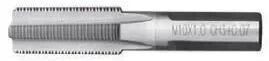
Figure 1 Straight-flute taps
Spiral-flute taps, as shown in Figure 2, are well suited to blind-hole thread machining, with chips evacuated rearwards during cutting. Due to the helix angle, the effective cutting rake angle of the tap increases with rising helix angle. For ferrous metal machining, a small helix angle of approximately 30° is selected to preserve the strength of spiral teeth. For non-ferrous metal machining, a larger helix angle of around 45° is adopted to achieve sharper cutting action.
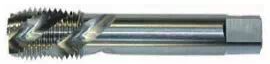
Spiral-flute taps, as shown in Figure 2
Spiral-flute taps feature helical flutes. During tapping, the rotary lifting effect of the helical flutes readily lifts chips out of the hole. This prevents chip residue or flute clogging, which leads to tap breakage and cutting edge chipping. Tool life is therefore extended, and high-precision threads can be produced. Cutting speed can be increased by 30%–50% compared with straight-flute taps, and a single tap can complete the full threaded hole.
Spiral-point taps, as shown in Figure 3, deliver excellent performance for non-ferrous metals, stainless steel and ferrous metals, and are the preferred option for through-hole thread machining. These taps adopt a large core diameter design for high rigidity and can withstand heavy cutting forces. A specialised gun-chamber flute geometry on the leading cutting edges enables smooth chip evacuation, low torque and stable dimensional accuracy for longer tool life. Spiral-point taps feature rotary chip ejection, which keeps flutes clean to reduce cutting resistance and prevents tap damage caused by chip clogging. Accordingly, spiral-point taps can machine high-precision threads at higher cutting speeds than standard hand taps, with chips ejected forwards during machining.

Spiral-point taps, as shown in Figure 3
As an advanced thread machining process, thread milling offers unique advantages and broader, more flexible application envelopes compared with tapping. The key benefits are listed below: ① High metal removal rate; ② Superior surface finish and dimensional accuracy; ③ Reliable process stability and operational safety; ④ Wide application range.
Thread milling is a versatile advanced machining technology, yet it has inherent limitations: ① It requires 3-axis CNC machine tools; ② Although component cost is lower in mass production, individual thread mills cost more than taps; ③ CNC programming is relatively complex, a major factor limiting widespread adoption.
With growing uptake of CNC machine tools, thread milling technology has been increasingly deployed in the mechanical manufacturing sector. Thread milling relies on 3-axis CNC machine tool linkage. Thread profiles are generated via helical interpolation using thread milling cutters. For one full rotary motion of the cutter in the horizontal plane, the cutter advances axially by one pitch.
A wide range of thread milling cutters are commercially available. The characteristics of common types are described below.
General-purpose indexable-insert thread mills
General-purpose indexable-insert thread mills are mainly used for milling large-diameter internal threads and can also machine external threads. The inserts are simple to manufacture and low-cost, but their impact resistance is slightly inferior to solid carbide thread mills. This tool is therefore commonly recommended for aluminium alloy machining. Its construction resembles conventional indexable milling cutters, consisting of a reusable toolholder and easily replaceable inserts. When selecting indexable-insert thread mills, select the largest feasible toolholder diameter and appropriate insert grade according to thread diameter, depth and workpiece material. General-purpose multi-edge indexable-insert thread mills, as shown in Figure 4.
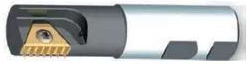
General-purpose multi-edge indexable-insert thread mills, as shown in Figure 4.
General-purpose solid carbide thread mills
General-purpose solid carbide thread mills, as shown in Figure 5, are mostly manufactured from solid carbide; many are equipped with surface coatings. Compact in structure, they suit small and medium-diameter threads, including tapered threads. These cutters have high rigidity. In particular, solid carbide cutters with helical flutes effectively reduce cutting load and boost productivity when machining hard materials. The cutting edges carry continuous thread-form teeth. A single helical pass completes full thread generation without layered cuts required for indexable tools, delivering high productivity at a higher purchase price. This tool type is commonly used for small and medium-diameter thread machining.
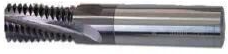
General-purpose solid carbide thread mills, as shown in Figure 5
Thread drill-mills
Thread drill-mills, as shown in Figure 6, are solid carbide tools for high-efficiency machining of small and medium-diameter internal threads. They complete three operations in a single pass: pilot hole drilling, hole chamfering and internal thread milling, reducing the total number of tools required. Their disadvantages are limited versatility and high tool cost. The tool comprises three sections: a leading drilling zone, central thread milling zone and chamfer edge at the root of the cutting profile.

Thread drill-mills, as shown in Figure 6
The diameter of the drilling section defines the minor diameter of the machinable thread. The thread machining sequence is shown in Figure 7. Restricted by the diameter of the drilling section, one thread drill-mill can only machine one specific thread size. When selecting a thread drill-mill, both the threaded hole specification and the match between the tool’s effective cutting length and workpiece hole depth must be considered; otherwise the chamfering function cannot be realised.
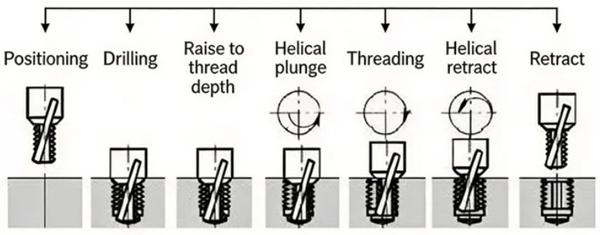
The thread machining sequence is shown in Figure 7
Modular Thread Milling Tool System
A notable trade-off exists between versatility and productivity for thread milling cutters. Multi-function tools such as thread drill-mills deliver high productivity but narrow application scope, while general-purpose tools often achieve lower metal removal rates. To address this challenge, modular thread milling tool systems have been developed, as shown in Figure 8. The system consists of a shank, counterbore chamfer inserts and general-purpose thread mills. Different counterbore chamfer inserts and thread mills can be selected according to machining requirements. This tool system offers good versatility and high productivity, but comes with elevated tooling cost.
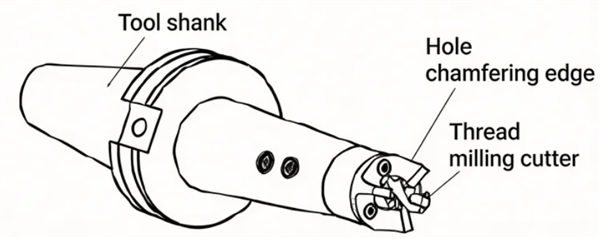
modular thread milling tool system
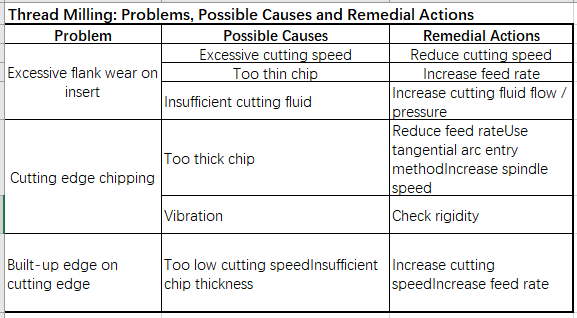
Like other milling cutters, thread mills experience insert wear, edge chipping and built-up edge during machining. The attached table lists typical issues encountered in thread milling and corresponding remedial actions.
This paper analyses tool selection for thread production based on the two mainstream threaded hole machining methods, describing the features, performance and application envelopes of each threading tool. Conventional tapping and modern thread milling each have distinct advantages and drawbacks. Tapping suffers from lower accuracy and accelerated tool wear yet offers high practicality. Thread milling provides superior surface finish and high dimensional accuracy, but involves high tooling cost and cumbersome CNC programming. Comprehensive evaluation of process capability, operability and economy is required for optimal process selection in real production. This improves productivity, reduces costs and produces high-quality, high-accuracy threaded holes.


