In fields such as mechanical manufacturing, automotive engineering, consumer electronics, and aerospace, surface engineering treatments of matrix materials directly determine the service performance and reliability of components.
For the same material, different surface‑treatment processes can lead to order-of-magnitude differences in corrosion resistance, wear resistance, electrical conductivity, and even aesthetic quality.
Therefore, the essence of surface treatment is not merely to enhance appearance; rather, by engineering a functional surface layer without substantially altering the bulk mechanical properties of the substrate, it enables targeted performance enhancement.
There is no absolute superiority or inferiority among different surface‑treatment processes; the key lies in whether they are suitable for the specific substrate, structure, functionality, and service environment. To truly understand surface treatment, one must look beyond the process name and instead examine how the coating forms, what problems it primarily addresses, and what new risks it may introduce.
Electroplating is a process in which, under the influence of an external direct current electric field, metal ions in the plating solution undergo reduction reactions at the cathode surface and are deposited to form a metallic or alloy coating.
The workpiece to be plated typically serves as the cathode, while the anode may be either a soluble metal anode or an insoluble anode. In addition to metal salts, the plating bath usually contains additives such as complexing agents, buffers, conductive salts, and brighteners.
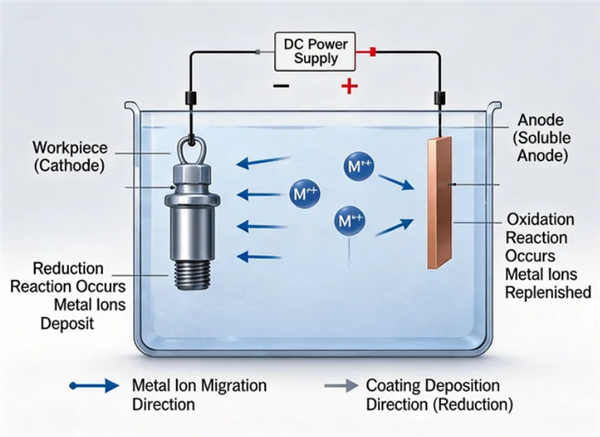
Schematic diagram of the basic principle of electroplating
Common plating coatings include: zinc plating, zinc–nickel alloy plating, nickel plating, copper plating, chromium plating, silver plating, gold plating, and composite systems such as electroless nickel followed by electroplating.
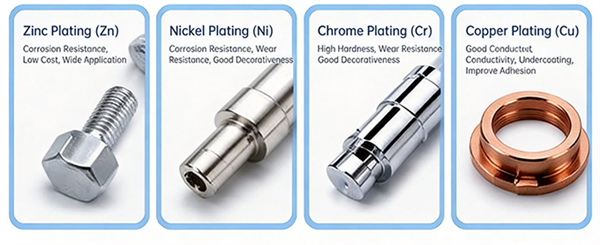
The functions of electroplating are not entirely the same. For example, zinc plating is primarily used for corrosion protection of steel parts; nickel plating serves both protective and wear‑resistant purposes as well as decorative applications; copper plating is often employed as a base layer, for electrical conductivity, or as a transition layer for subsequent platings; gold and silver plating are commonly used in electrical contacts and high‑end decorative finishes; and hard chrome is frequently applied for wear resistance and dimensional restoration.
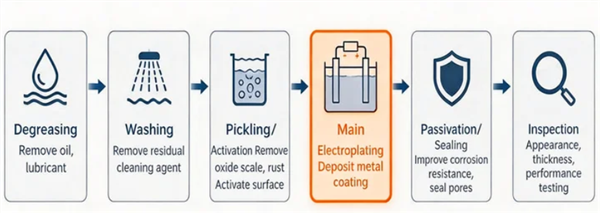
Electroplating typically involves three stages.
Pre‑treatment: degreasing → water rinsing → rust removal or acid pickling → water rinsing → activation →, if necessary, pre‑plating or underplating
Pre‑treatment directly determines the adhesion of the coating. Residual oil, oxide scale, rust, or polishing wax on the substrate surface can all lead to blistering, pinholing, and localized peeling of the coating.
It should be noted that passivation is typically a post‑plating treatment, rather than a standard step in conventional pre‑plating preparation. Although certain substrates may undergo specific conversion or activation processes, “pickling followed by passivation” cannot be regarded as a universal procedure for all electroplating operations.
Main electroplating: By controlling current density, bath temperature, pH, metal ion concentration, additive levels, and agitation conditions, the coating is deposited as specified.
Post‑treatment: Water rinsing → Passivation or sealing → Drying → Inspection → Packaging
Galvanized parts are typically subjected to trivalent chromium passivation, chromium-free passivation, or sealing treatments to further enhance their corrosion resistance.
For plastic substrates such as ABS, conventional electroplating cannot be applied directly; instead, the surface typically undergoes roughening, sensitization, activation, and chemical deposition to first form a conductive layer before proceeding to subsequent plating steps.
Electroplating quality is typically influenced by the following parameters:
Parts with complex geometries, deep holes, or recesses are prone to uneven current distribution, leading to excessive plating at edges and insufficient plating in deep cavities. These issues can be addressed by employing auxiliary anodes, shielding plates, optimized rack designs, or by enhancing the bath’s throwing power.
The advantages of electroplating include a wide variety of coating types, enabling it to simultaneously meet requirements for corrosion resistance, wear resistance, electrical conductivity, weldability, and decorative purposes, with coating thickness typically adjustable from a few micrometers to several tens of micrometers.
The main risks include:
In particular, high-strength steel fasteners, spring components, and load-bearing parts must have their hydrogen embrittlement risk assessed and undergo dehydrogenation treatment promptly in accordance with applicable requirements.
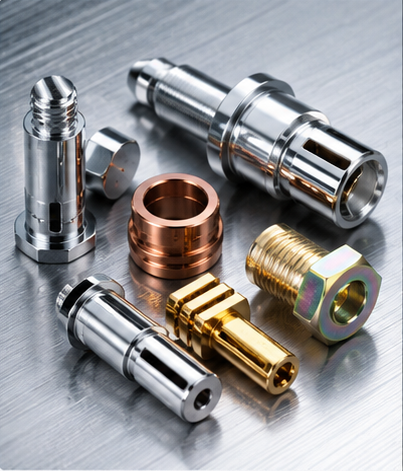
Justway supports these electroplating surface treatments:


