 Transparent Materials Look Alike, Yet Real‑World Performance Depends on Service Conditions
Transparent materials are easy to misjudge. A clear storage box, lamp shade, safety goggle or beverage bottle may all look bright‑clear, yet they can be made from completely different polymers.
PC, PMMA, PS and PET are among the most widely‑used transparent plastics. While all deliver visual transparency, their practical distinctions lie not in “how clear they look”, but in impact resistance, scratch resistance, heat resistance, outdoor‑weathering performance and cost constraints.
Transparency itself is not the deciding factor; application requirements define material selection.
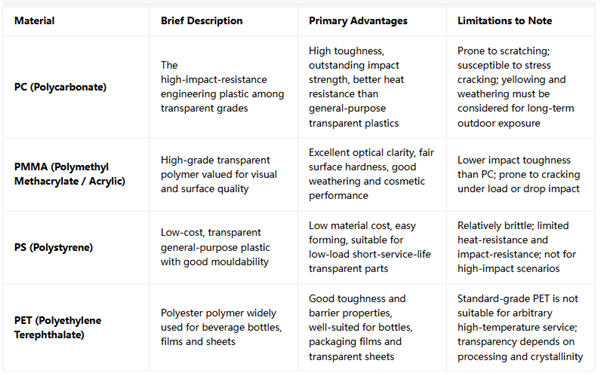
The table below provides a quick‑reference overview for preliminary evaluation of appearance, processing and impact‑performance requirements for transparent components.
The appearance, processing and impact resistance requirements of transparent parts are not the same.
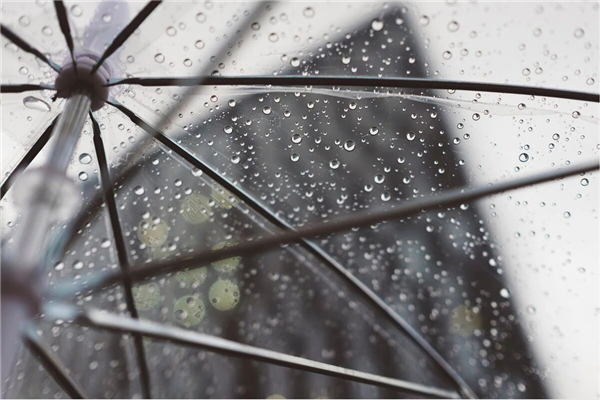
Transparency is only a visual property and does not guarantee equivalent mechanical performance.
Transparency describes only visual output, not material performance. Many transparent parts look bright‑new out‑of‑the‑box, yet diverge drastically in service.
Some shatter upon impact; others deform without fracture. Some scratch rapidly; others retain clarity after years outdoors. Some serve as safety guards, while others are only fit for packaging boxes. Real‑world gaps stem from toughness, strength, heat resistance, weathering, chemical resistance and processing options.
Poor question: Which material is the most transparent?
Better question: Does the part require impact resistance? Scratch resistance? Outdoor exposure? Contact with hot water, oil, alcohol or cleaning agents?
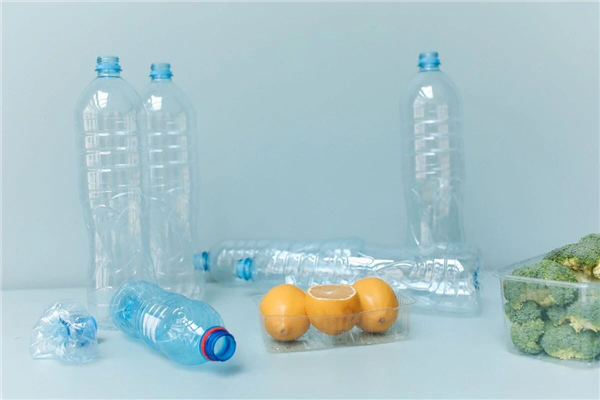 Requirements for bottles, packaging, display hardware and safety components vary significantly.
Fragmentation‑risk prevention is critical, so impact resistance is prioritized. PC is widely adopted for its high toughness and impact performance. However, PC surfaces scratch easily, so hard‑coating is applied for many applications.
Key criteria: impact resistance, scratch performance
Optical clarity, visual appearance and surface texture are top priorities. PMMA is common for its premium transparency and compatibility with cutting and polishing. Note that it cannot simply substitute glass when high‑impact loading is expected.
Key criteria: optical clarity, surface aesthetics
For low‑stress, short‑lifespan, cost‑sensitive products, PS offers advantages. It is transparent and easy to mould, yet brittle and prone to fracture under drop, squeeze or low‑temperature impact.
Key criteria: cost‑effectiveness, service‑life expectations
PET dominates packaging for bottles, films and sheets due to good toughness and barrier performance. Nevertheless, standard PET bottles are not automatically rated for hot‑water filling or continuous high‑temperature use; always follow product labelling and application specifications.
Key criteria: packaging functionality, service‑temperature constraints

Differences between polymers become pronounced under daylight exposure, protective‑function duties and outdoor operating conditions.
PC is merely one transparent polymer option. PMMA, PS, PET, PETG, transparent ABS and transparent PP can also deliver transparent or semi‑transparent appearances. Visual inspection alone cannot reliably identify polymer types.
PMMA does have lower impact toughness versus PC. Still, its outstanding optical clarity, surface hardness and weathering performance make it a premium aesthetic‑focused material for displays, signage, light‑fixture housings and decorative parts — not merely a cheap substitute.
Standard beverage‑grade PET does not equate to universal high‑temperature suitability. Permissibility for hot‑water filling, repeated reuse, oil/acid‑base contact depends on polymer grade, product design and regulatory labelling.
PC is generally more expensive than PS, yet PS may be the optimal choice for single‑use packaging. PMMA under‑performs PC in impact resistance but out‑performs it for many display‑oriented applications. Material selection prioritizes application fit over raw‑material cost.
For preliminary screening:
For detailed specification work, clarify these requirements: outdoor exposure duration, long‑term static/dynamic loading, drop‑impact risk, exposure to alcohol/cleaners/oils/food media, heat‑resistance targets, flame‑retardant requirements and compliance‑test‑report expectations.
PC, PMMA, PS and PET can all produce transparent components — but they represent fundamentally different forms of “transparency”.
PC is a performance‑oriented transparent polymer for protection‑critical parts. PMMA is an appearance‑driven transparent polymer. PS is an economy‑focused transparent polymer. PET is a packaging‑specialized transparent polymer.
When evaluating transparent materials, do not judge purely by visual brightness. Always assess what functional duties the finished component must fulfil.


