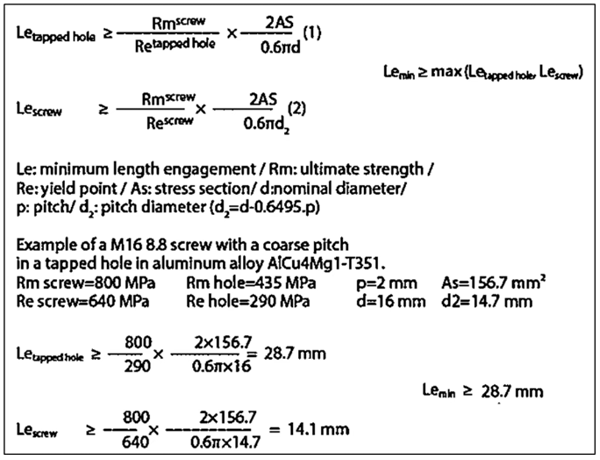
Summary: Explains why thread load is concentrated in the first few threads, and how this guides CNC design choices for nut height and minimum threaded hole depth.
During a recent technical discussion, we talked about the load distribution on screw threads. The two figures shared were meant to illustrate that thread loading is not uniform: the first three threads typically carry more than 70% of the load, and within about six threads, essentially the entire load is taken up.
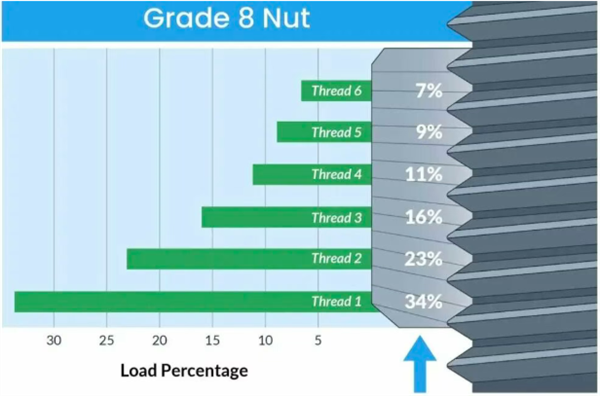
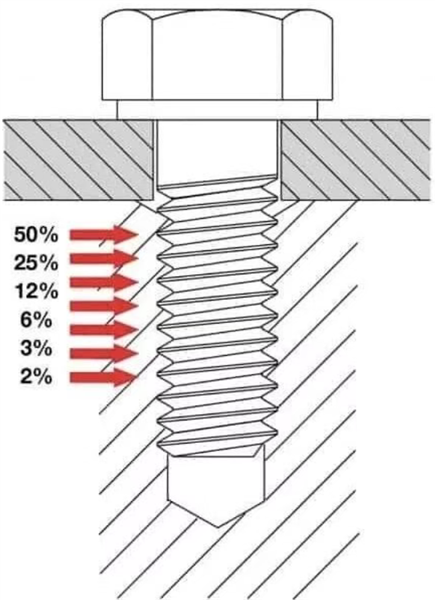
Based on this, we can extend the discussion to nut height and threaded hole depth design.
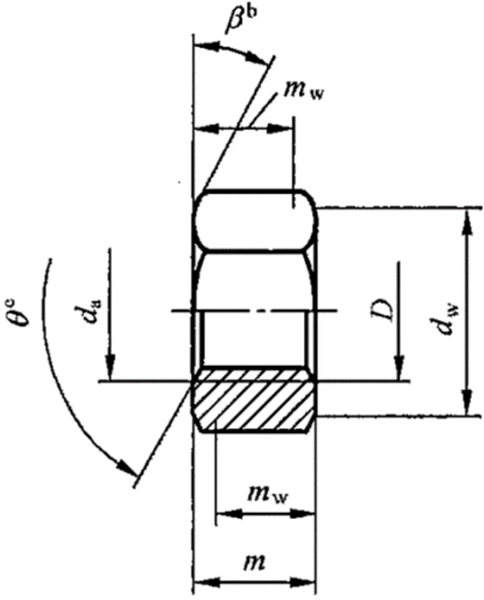
First, consider nut thickness. As shown in the figure below, the standard nut thickness dimension m can be found in national standards. If you subtract the two chamfers from this dimension, the remaining effective threaded length is roughly equal to six pitches, or about six engaged threads. This height is a good compromise: it satisfies the load-bearing requirement while keeping material usage to a minimum.
Next, consider threaded hole depth. When the plate is thin, or when there is not enough depth to machine a tapped hole on a casting, a common rule of thumb is to provide an effective thread depth of at least one thread diameter. This guideline also comes from the principle above, since it helps ensure approximately six effective threads. For common carbon steel materials, this is usually adequate. For softer materials such as aluminum or copper, it is better to provide an effective thread length of about two times the thread diameter. These are empirical values. If a more precise result is needed, the minimum thread engagement length Lemin can be calculated using the appropriate method.