

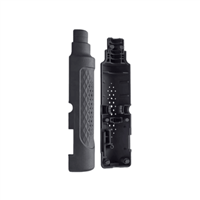
Do you want to test your design with this material? Hurry up and upload your part for inquiry
Request Quotes
HP PA12 40% GF
Material type: Thermoplastic / Polyamide 12 (PA12) reinforced with glass fiber (GF)
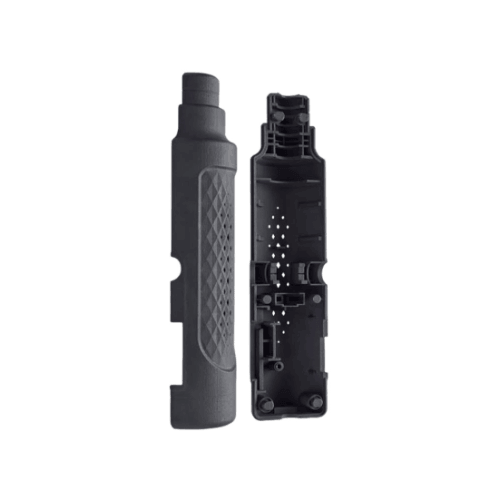
HP PA12 40% GF is a glass fiber-reinforced Nylon 12 developed specifically for HP Multi Jet Fusion (MJF). Adding glass fiber markedly improves stiffness, strength, and thermal stability over standard PA12, making the material suitable for demanding functional applications.
Process compatibility
Material Color
Black (dyed)
grey (natural)
Material advantages
- High stiffness and strength: glass fiber reinforcement delivers excellent rigidity and strength, with a tensile modulus of 3200 MPa and tensile strength of 55 MPa.
- Superior heat resistance: thermal stability is outstanding, with a heat deflection temperature (HDT) of up to 180 °C at 0.45 MPa, making the material suitable for high-temperature environments.
- Excellent dimensional stability: low warpage and high dimensional accuracy make it ideal for precision parts.
- Good chemical resistance: it withstands oils, greases, solvents, and many other chemicals.
- Cost-effective production: powder reusability of up to 70% reduces waste and cost per part.
- No support structures: for most geometries, MJF technology requires no support structures, which enables complex designs.
- Superior heat resistance: thermal stability is outstanding, with a heat deflection temperature (HDT) of up to 180 °C at 0.45 MPa, making the material suitable for high-temperature environments.
- Excellent dimensional stability: low warpage and high dimensional accuracy make it ideal for precision parts.
- Good chemical resistance: it withstands oils, greases, solvents, and many other chemicals.
- Cost-effective production: powder reusability of up to 70% reduces waste and cost per part.
- No support structures: for most geometries, MJF technology requires no support structures, which enables complex designs.
Material shortcomings
- Reduced ductility: the glass fiber content substantially lowers elongation at break (approximately 3.5%), making the material more brittle and less flexible than unfilled PA12.
- Higher material cost: glass fiber reinforcement makes it more expensive than standard PA12.
- Specialized equipment required: it needs HP MJF printers, which not all service providers have.
- Limited color options: it is available only in natural gray and cannot be dyed as easily as standard PA12.
- Surface roughness: glass fibers can produce a slightly rougher surface finish than unfilled PA12.
- Abrasive to tools: the glass fibers are abrasive and can wear down cutting tools during post-processing.
- Higher material cost: glass fiber reinforcement makes it more expensive than standard PA12.
- Specialized equipment required: it needs HP MJF printers, which not all service providers have.
- Limited color options: it is available only in natural gray and cannot be dyed as easily as standard PA12.
- Surface roughness: glass fibers can produce a slightly rougher surface finish than unfilled PA12.
- Abrasive to tools: the glass fibers are abrasive and can wear down cutting tools during post-processing.
Recommended description
HP PA12+GF is a high-performance, glass fiber-reinforced nylon for MJF 3D printing. Compared with standard PA12, it offers superior stiffness, strength, and heat resistance (up to 180 °C). It is ideal for functional prototypes and end-use parts that demand high rigidity, dimensional stability, and thermal performance in demanding environments. Note, however, that its lower ductility and greater brittleness make it less suitable for parts requiring flexibility or high impact resistance.
Properties
| Name | |
|---|---|
| Tensile Strength at Maximum Load (XY) | 30 MPa / 4,350 psi, ASTM D638 |
| Tensile Strength at Maximum Load (Z) | 30 MPa / 4,350 psi, ASTM D638 |
| Tensile Modulus (XY) | 2,800 MPa / 406 ksi, ASTM D638 |
| Tensile Modulus (Z) | 2,900 MPa / 421 ksi, ASTM D638 |
| Elongation at Break (XY) | 6.5%, ASTM D638 |
| Elongation at Break (Z) | 6.5%, ASTM D638 |
| Izod Notched Impact Strength (3.2 mm, 23 °C) | XYZ 2.7 kJ/m², ASTM D256 Test Method A |
Common applications
• Structural components that are load-bearing and rigid
• Automotive parts such as under-hood components, brackets, and housings
• Aerospace brackets requiring lightweight rigidity
• Industrial tooling and fixtures, including durable jigs and manufacturing aids
• Electronic enclosures with good thermal stability
• Machinery components such as gears, bearings, and other mechanical parts
3d-printing resources for engineers
 Article
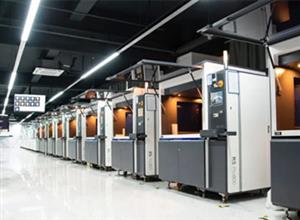
Justway Nylon 3D Printing: High-Quality Delivery Defines New Industry Standards
By
saman
May 22,2026
Article
Transparency in Manufacturing: Mastering Quoting, Lead Times, and Technical Collaboration
By
saman
Apr 24,2026
Article
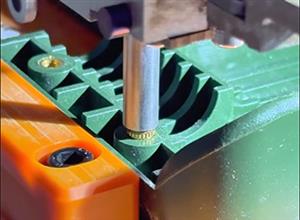
Mechanical Reliability: Advanced Threaded Insert Installation and Precision Marking
By
saman
Apr 23,2026
Article
Material Intelligence: Understanding Polymer Properties and Inherent Process Phenomena
By
saman
Apr 22,2026